Category Archives: Law

Where is the speed zone ordinance? @ LCC 2011-01-10


Lowndes County won’t install speed control devices:
policy or ordinance or “decision”, by whom and when?
And where is the speed zone ordinance they passed in January 2011,
according to the

Work Session Minutes of 10 January 2011:

Adoption of the Revised Speed Zone Ordinance,

County Engineer, Mike Fletcher,
presented the Commission with a revised speed zone ordinance
in accordance with Georgia Department of Transportation (GDOT)
requirements. Mr. Fletcher added that 2 once approved, staff would send
the document back to GDOT for execution. Commissioner Evans questioned
the speed limit on Boring Pond Road. Mr. Fletcher explained that since
the road has been paved, the new ordinance will allow for the new speed
to be posted at 45 mph and 55 mph. Mr. Fletcher added that prior to the
road being paved, the speed limit was 35 mph. Commissioner Raines asked
if the document was a county ordinance. Mr. Fletcher replied yes, adding
while the county can make certain recommendations, GDOT prepares the draft
in accordance with their regulations.

Chairman Paulk asked Mr. Fletcher
to provide those in attendance with a short explanation of speed control
devices. Mr. Fletcher explained that in the 1990’s a previous Commission
made the decision that speed control devices would not be allowed
on county roads due to maintenance and safety issues. Mr. Fletcher
added that over time that decision has become policy.

Commissioner
Powell stated he had received a request from citizens to increase the
speed limit on portions of Old Clyattville Road to 55 mph. Mr. Fletcher
replied that due to the curb and gutter installed on the road, he would
not recommend it. Mr. Fletcher added he would be glad to check with GDOT
to see what the state’s recommendation might be. Commissioner Powell
asked Mr. Fletcher to move forward with contacting GDOT.

When “in the 1990’s” was this Commission decision made?
In which minutes can we see the vote and the text of this decision?

And how is policy made?
By the Commission in an open meeting, or by the staff
at some unspecified “over time”?

Plus, where is this speed zone ordinance?

-jsq

Special assessment: ordinance or policy? @ LCC 2011-01-10


Ordinance or policy?
In the

Work Session Minutes of 10 January 2011

the special assessment rate is set “in accordance with Lowndes County’s
financial policies”:

Special Assessment Rate for 2011,

Finance Director, Stephanie Black, presented the proposed special
assessment rate at 5.25% (two percent above prime), in accordance
with Lowndes County’s financial policies. Commissioner Raines asked
if the rate would fluctuate through the year in the event the prime
rate adjusted. Ms. Black answered that the county is required to set
the rate annually so the actual prime rate would not be considered
again until the beginning of next year.

Yet

yesterday she said
:

“It’s just always been set at 2% above prime.
I believe it’s in your ordinance.”

Which is it, a policy or an ordinance?
Maybe it’s a policy set in an ordinance.
If so, which ordinance?
Is it one of the

dozen on the county’s website

or is it one of the many more that are not?

-jsq

PS: Owed to Jane Osborn.

Work Session Minutes @ LCC 2011-01-10

Ordinance or policy?
That question comes up for at least two items,


Special assessment

and

Speed control devices
,
in the

minutes of the 10 January 2011 Work Session

of the Lowndes County Commission.
-jsq

LOWNDES COUNTY BOARD OF COMMISSIONERS

MINUTES

WORK SESSION

Monday, January 10, 2011

Continue reading

Rural AIDS: poverty the cause, solar power part of the solution


Director Lisa Biagiotti
spent two years travelling around the South
interviewing people about AIDS to make a film,
deepsouth.
She found rural AIDS is a bigger and faster-growing problem
than AIDS in center cities,
yet most health and prevention funding goes to urban areas.
The root cause seemed clear to her: poverty.
Here’s some deeper dirt (literally) on rural poverty in the U.S.,
and one thing we know can help with that: distributed solar power,
for jobs, for reduced electrical bills, and for energy independence.
What politician wouldn’t want jobs for their constituents?

The director said the screening at

VSU at the end of November
drew more people than the
day before in Little Rock.
There were clearly more than 150 in the audience in Valdosta.
It’s a topic very relevant to here, as

Dean Poling wrote in the VDT 26 November 2012,

Organizers note that Georgia is ranked sixth highest nationally for
its cumulative number of AIDS cases reported through December 2009.
More than 40,000 known HIV/AIDS cases were reported in Georgia as of
2010.

The South Health District’s 10 counties, which include Lowndes and


surrounding counties, report 950 confirmed cases of HIV/AIDS, while
many more are likely infected and risk becoming sick because they
are not being treated. More specifically, there are about 460
reported cases in Lowndes County.

In reporting these numbers, HIV is the virus (HIV disease) and AIDS
is the medical diagnosis made by a doctor of the symptoms, according
to South Health District.

It’s a great movie and I highly recommend it.
Director Biagiotti spent a substantial amount of her own money and two years to make
this film, yet there are aspects she could only note in passing,
such as incarceration.
She can’t be expected to have researched every aspect;
maybe somebody else can step up and help follow more threads.

The movie starts with some maps about poverty and AIDS in the South.
It did not, however, look outside the South for poverty.
Here are better
poverty maps, from the CDC:


Continue reading

How to get fast Internet service —Susan Crawford

Susan Crawford has a plan

for getting us fast Internet access
for jobs, community, education,
and health care.


Susan Crawford wrote for Wired 2 October 2012,

We Can’t All Be in Google’s Kansas: A Plan for Winning the Bandwidth
Race
,
about how the incumbent telephone and cable companies that provide
our Internet access aren’t going to help:

They have no incentive to do so. Because they never enter one
another’s territories, they don’t face the competition that might
spur such expansion.

Instead, incumbent internet access providers such as Comcast and
Time Warner (for wired access) and AT&T and Verizon (for
complementary wireless access) are in “harvesting” mode.
They’re raising average revenue per user through special pricing for
planned “specialized services” and usage-based billing,
which allows the incumbents to constrain demand. The ecosystem these
companies have built is never under stress, because consumers do
their best to avoid heavy charges for using more data than they’re
supposed to. Where users have no expectation of abundance, there’s
no need to build fiber on the wired side of the business or build
small cells fed by fiber on the wireless side.

If the current internet access providers that dominate the American
telecommunications landscape could get away with it, they’d sell
nothing but specialized services and turn internet access into a
dirt road.

So what is her plan?

Continue reading

Captive cable audience —Susan Crawford


Affordable high-speed Internet access would bring us
jobs, community, “online commerce and services, the ability to reach world
markets, to invent and innovate, to learn and communicate” and
“a wealth of economic activity and information”
writes Susan Crawford, a very savvy and experienced communications law professor
who has been recommended by many as a potential chair of the FCC,
who also explains why we aren’t currently getting it.

The Diane Rehm Show 10 January 2013,

Susan Crawford: “Captive Audience”
,
and that’s the title of her book,

Captive Audience: The Telecom Industry and Monopoly Power in the New Gilded Age
,
excerpted here:

The sea change in policy that led to the current situation has
been coordinated over the past twenty years by legions of lobbyists,
hired-guneconomists, and credulous regulators. The cable companies
have no incentive to upgrade their core network hardware to ensure
that advanced fiberconnections are available to every home
throughout the country. Communications companies describe globally
competitive high-speed access as aluxury, just as the private
electricity companies did a century ago.

Yet communications services are now as important as electricity.

Today if you asked American mayors what technology they most want
for their city, the majority would say, “affordable high-speed
Internet access.”
And they want these networks not simply for
the jobs created to construct them but because the Internet brings
the world to their community.

High-speed Internet access gives towns
and cities online commerce and services, the ability to reach world
markets, to invent and innovate, to learn and communicate. It brings
a wealth of economic activity and information.

But despite these
manifold benefits, Americans continue to treat such services as the
exclusive domain of private monopolies and as luxuries
obtainable only by the wealthy.

Not coincidentally, the United States has fallen from the forefront

Continue reading

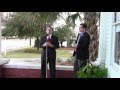
Rep. Austin Scott (R GA-08) @ VLCoC 2013-01-10


Ron Borders

introduced

Congressman Austin Scott (R GA-08)
who

made some remarks

on the front porch at the Chamber of Commerce Thursday 10 January 2013.

Bookended by some formulaic remarks about debt
(without mentioning
that
it’s already mostly solved
),
the Congressman noted he is on the Committee on Armed Services.
He said there is no current

BRAC (Base Realignment and Closure Commission)
,
although one has been asked for.
He said a BRAC wouldn’t do anything for near-term debt, anyway
(but he didn’t say anything about ending the war in Afghanistan
or stopping funding for un-needed weapons systems as ways of saving money).

He said he is the chair of a House Agriculture Subcommitee
(Horticulture, Research, Biotechnology, and Foreign Agriculture).
He said he was for research, for the agricultural extension,
and for agricultural exports.

Here’s

the WCTV news report,
with responses by Gretchen Quarterman,
Chair of the Lowndes County Democratic Party (LCDP).

Here’s

a video playlist:

Continue reading

Georgia legislature still trying to suck up Tennessee River water

Because Atlanta can’t get a grip on its water usage, the Georgia legislature
is still trying to suck up Tennessee River water.
If the legislature is willing to try that, how long before they
try sucking up our Floridan Aquifer water for Atlanta?


Prefiled in December to be up early as the Georgia legisture starts meeting
today, is a bill to try to move the northern border of Georgia to match
an eighteenth century boundary that just happens to include a bit of the
Tennessee River in Georgia.
HR 4,

Georgia and Tennessee; boundary dispute; propose settlement
,
was filed by

Rep. Harry Geisinger, R – Roswell, District 48,

and says in part:

WHEREAS, the State of Georgia proposes to the State of Tennessee
that the dispute be resolved by the states agreeing that the current
boundary between the two states reflecting the flawed 1818 survey be
adopted as the legal boundary between the states except for an area
described as follows which shall be made a part of the State of
Georgia by which Georgia shall be able to exercise its riparian
water rights to the Tennessee River at Nickajack:

Georgia is already in a

three-decade-long dispute with Alabama and
Florida over the Chattahoochee River.

Does adding a dispute over the Tennessee River
seem like a good idea to you?

And how can we best stop Atlanta from coming for our Floridan Aquifer?

-jsq

The water is not lost. —Forrest H. Williams


Valdosta resident Forrest H. Williams replied in the VDT today to

my op-ed of 6 January.

His information seems a bit out of date.
For example, he cites

Progress Energy’s Crystal River nuke

as a good example, when it’s been

down since 2009

and is still

producing zero percent power
,
both according to the NRC.
Readers of this blog know that

the blog version of my op-ed

already links to sources for everything I said.
I may respond more later, but no doubt there are other people
who want to get involved in this discussion.
And I do thank Forrest H. Williams for airing the sort of disinformation
that is out there, so others can dispel it.

Oh, and saying water that is evaporated is not lost is like saying trees that are burned are not lost. Evaporated water is not available for agricultural or wildlife or drinking water use, and thus is indeed lost.

Continue reading

Gretchen LCDP v. Austin Scott GA-08 on WCTV


Gretchen with LAKE video camera

Hearing a representative was in town, Gretchen took the LAKE video camera
down to the Chamber of Commerce.
Greg Gullberg of WCTV invited her to rebut Rep. Austin Scott (R GA-08)
in her role as Chair of the Lowndes County Democratic Party (LCDP).
After some back and forth,

the WCTV story

shows transparency winning, and Gretchen with the last word.


Rep. Scott GA-08


Gretchen as LCDP Chair

But their [sic] is one thing they both agree on.

“I quite honestly think both sides ought to put their budgets on
C-Span and maybe we ought to have those negotiations on C-Span,”
said Scott.

“So I’m all for having everything all out on the table for all
citizens to see,” said Quarterman.


Scott speaking


Gretchen speaking


Hey, what if

the Lowndes County Commission put its board packets and budgets out on the web

for all us taxpayers to see?

Here’s
the WCTV video.
The video Gretchen took will follow.

Continue reading