Just a decade ago, private prisons were a dying industry awash in corruption and mired in lawsuits, particularly Corrections CorporationWe’d already heard from Bloomberg that Continue readingof America (CCA), the nation’s largest private prison operator. Today, these companies are booming once again, yet the lawsuits and scandals continue to pile up. Meanwhile, more and more evidence shows that compared to publicly run prisons, private jails are filthier, more violent, less accountable, and contrary to what privatization advocates peddle as truth, do not save money. In fact, more recent findings suggest that private prisons could be more costly.
So why are they still in business?
In a recently published report, “Banking on Bondage: Mass Incarceration and Private Prisons,” the American Civil Liberties Union examines the history of prison privatization and finds that private prison companies owe their continued and prosperous existence to skyrocketing immigration detention post September 11 as well as the firm hold they have gained over elected and appointed officials.
Category Archives: Law
Fighting gangs by legalizing pot
Richard Orange wrote for GlobalPost yesterday, A win-win on drugs? Fighting gangs by legalizing pot,
Not just drug toleration. Legalization: Continue readingCopenhagen’s city municipality voted in recent weeks, 39 votes to 9, to empower its social affairs committee to draw up a detailed plan to legalize cannabis.
If that plan is approved by Denmark’s new left-of-centre parliament next year, the city could become the first to legalize marijuana, rather than simply tolerate it, as police do in the Netherlands.
“We are thinking of perhaps 30 to 40 public sales houses, where the people aren’t interested in selling you more, they’re interested in you,” Mikkel Warming, the mayor in charge of social affairs at Copenhagen City Council told GlobalPost. “Who is it better for youngsters to buy marijuana from? A drug pusher, who wants them to use more, who wants them to buy hard drugs, or a civil servant?”
We’re not done working on this —Jason Davenport @ GLPC 28 November 2011
Continuing the
Comprehensive Plan Short Term Work Program (STWP) updates,
the chairman asked if the board was ready
Lowndes County Planner Jason Davenport responded:
We’re not done working on this. But if you think it’s time to bring it before y’all.
Later, at about 11:40 in, Davenport clarified:
And the only that’s different right now is Lowndes County. Because Lowndes County did not hold a public hearing as required, so we’re on a different timeline. And if Mrs. Quarterman would have given me about until December 13th she would have seen that.That would be the initial resolution the countyBecause our initial resolution was not the same as the other communities. We’re on a little bit of a different timeline because we have to address that issue. That’s one thing; the county in this instance will be handled a little different than some of the smaller cities and Valdosta.
did not provide in response to an open records request about the draft
the county did not publish as
required by the state.
If the county had answered questions weeks ago,
instead of waiting until they had to do makeup homework,
nobody would have had to ask about it at that GLPC meeting….
Anyway, the County Planner has said there will be a public hearing. However, remember it was the County Chairman who said that the public hearing item on the agenda was not really a public hearing. It’s the Chairman, not the Planner, who sets the agendas for the County Commission. We’ll see what’s on the 13th December County Commission Agenda, and whether it really is handled as a public hearing in that meeting.
Then GLPC Board Member John Page expressed his concerns: Continue reading
Don’t we still need farmers to feed us? —Gretchen Quarterman @ GLPC 28 November 2011
Could it be the many items the county is deleting, having to do with
feeding seniors, health care, transportation,
work ethics and life skills,
environmental impacts, agriculture, wells, wetlands, and many other topics,
some of which Gretchen Quarterman detailed to the Greater Lowndes Planning Commission yesterday?
After Valdosta and Hahira City Planner Matt Martin explained how all the local city governments had or were going to have hearings about their Comprehensive Plan Short Term Work Program updates, the GLPC Chairman asked if any citizens wanted to speak on that topic. One citizen did, Gretchen Quarterman. She apologized for missing the September GLPC meeting because she would have raised some of these issues then.
I have an appointment with [Lowndes County Planner] Jason [Davenport] tomorrow to address some of my questions.She said she would provide written comments to Jason the next morning, and asked if GLPC would like to hear some of them. They said they would, so she read some of them. For example:But I want to let you know that at the County Commission did not hold a public hearing after the changes. I was at the [Valdosta] City Council meeting, and the City Council did hold a public hearing, but the County Commission did not.
And I believe that is in violation of DCA’s guidelines. They sent a transmission letter that said they followed DCA’s guidelines. DCA’s guidelines say hold a public hearing. It was on the agenda, the public hearing, but no public hearing was held. So I didn’t have an opportunity to see the document, or to comment, before the county sent it.
In Section 1.3 it was struck from the document:Continue readingEnsure supporting senior services such as health care,
Transparent government is totally what my heart is about. —Gretchen Quarterman
I repeatedly apologized to County Planner Jason Davenport
about an earlier misunderstanding about the
“public hearing” agenda item, which the Chairman stated was not really
a public hearing and for which no citizens were allowed to speak:
7.b. Greater Lowndes 2030 Comprehensive Plan Updates – Lowndes County Report of Accomplishments (ROA) and Short Term Work Program (STWP)Then I said:
Transparent government is totally what my heart is about. And I think that people trust the government more when we can see the business done in public. And I really appreciate when you do things in public and you ask questions in the work sessions so everybody can hear.The VDT’s version was:
The lone citizen to be heard, Gretchen Quarterman, thanked commissioners for their observance of open government and apologized to County Planner Jason Davenport for things she said to him prior to the meeting, due to a “misunderstanding,” she said.
After the meeting adjourned, Chairman Ashley Paulk apologized to me in public Continue reading
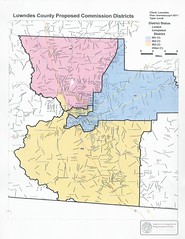
Last call for Georgia redistricting comments
Continue readingGeorgians have until Dec. 23 to comment on new state and congressional district maps. The U.S. Department of Justice is in the midst of its 60 day-review of the maps. Voter advocate groups say this may be the last chance to comment before the maps go into effect for a decade.
…
Elizabeth Poythress, president of the League of Women Voters of Georgia, says the Justice Department is eager to receive citizen comment.
“We’re just encouraging people to take the advantage they have
CUNY’s idea of a public meeting
That’s in a NYTimes story by Alice Speri and Anna M. Phillips, CUNY Students Protesting Tuition Increase Clash With Police. Interesting title considering that the content says that the public went to a public meeting and were violently attacked by police.Carlos Pazmino, 21, a City College student who helped organize the protest, said that after students began opening doors to the auditorium where the CUNY trustees were to hold a public hearing at 5 p.m., CUNY police officers surrounded the entrances and pushed back, using their batons, and that when students formed a line to push past, the officers began hitting the students with the batons.
“I saw two people knocked down by cops,” Mr. Pazmino said. “They were arrested and one guy’s head was bleeding.”
And that’s the cleaned up version: Continue reading
Militarization of Police and Private Prison Profiteering: the Connection
Norm Stanager wrote for YES! Magazine (via AlterNet) 17 November 2011, Police Chief Who Oversaw 1999 WTO Crackdown Says Paramilitary Policing Is a Disaster
Did anybody consider informing the protesters of the issues and asking for cooperation, or checking to see if there were alternate routes for emergency vehicles, or…. Hey, I’m not a professional emergency responder, but surely there must be a plan B in case some major intersection is out of commission due to a water main blowout, natural gas leak, earthquake, or whatever.Then came day two. Early in the morning, large contingents of demonstrators began to converge at a key downtown intersection. They sat down and refused to budge. Their numbers grew. A labor march would soon add additional thousands to the mix.
“We have to clear the intersection,” said the field commander. “We have to clear the intersection,” the operations commander agreed, from his bunker in the Public Safety Building. Standing alone on the edge of the crowd, I, the chief of police, said to myself, “We have to clear the intersection.”
Why?
Because of all the what-ifs. What if a fire breaks out in the Sheraton across the street? What if a woman goes into labor on the seventeenth floor of the hotel? What if a heart patient goes into cardiac arrest in the high-rise on the corner? What if there’s a stabbing, a shooting, a serious-injury traffic accident? How would an aid car, fire engine or police cruiser get through that sea of people? The cop in me supported the decision to clear the intersection. But the chief in me should have vetoed it. And he certainly should have forbidden the indiscriminate use of tear gas to accomplish it, no matter how many warnings we barked through the bullhorn.
My support for a militaristic solution caused all hell to break loose. Rocks, bottles and newspaper racks went flying. Windows were smashed, stores were looted, fires lighted; and more gas filled the streets, with some cops clearly overreacting, escalating and prolonging the conflict. The “Battle in Seattle,” as the WTO protests and their aftermath came to be known, was a huge setback—for the protesters, my cops, the community.
This article was published a few days before the UC Davis pepper spray events, but the author explicitly cites what happened to Scott Olsen in Oakland and the arrests in Atlanta, saying those are continuations of the same problems he experience in Seattle in 1999.
Then he gets into why: Continue reading
Mic check stops a police riot at UC Davis
By now you’ve probably seen the video of UC Davis police pepper spraying peaceful protesters who were simply sitting on the gorund.
But have you seen what happened next?
Police were forming up with weapons raised surrounded on three sides by protesters, when someone yelled “Mic check!”
Follow
this link.
Or, if you want to see it starting with the pepper spraying:
The one with the two pepper spray cans appears to be the same police lieutenant who pepper sprayed the protesters. As the protesters say through the human microphone that they are willing to let the police just walk away, even after the police had assaulted them with pepper spray, that same lieutenant motions to the police, who lower their weapons and back away.
FVCS Final Meeting 15 November 2011
Sam Allen,
as he has before,
called for
reconciliation of opponents on the recent school consolidation referendum,
and support of the two school systems,
financially and otherwise.
In addition to FVCS regulars such as JC Cunningham, Chamber Chair Tom Gooding was there, as were current Valdosta Mayor Sonny Vickers and Mayor-Elect John Gayle, plus re-elected Valdosta City Council At-Large Ben Norton. Valdosta School Superintendent Cason was there. I didn’t see Lowndes Superintendent Smith, although various members of Continue reading